
When Someone Searches for a Lawyer, Does Your Firm Show Up?
Somebody needs a lawyer. Maybe it’s a car accident, a lease dispute, a divorce they’ve been putting off for months. Customers don’t always call a friend for a referral first anymore. They open Google and type “lawyer near me” or “personal injury attorney in [city].” Increasingly, they just ask ChatGPT or Google’s AI Overview to explain their situation and tell them who to call.
That’s two separate moments. Your firm either shows up, or it doesn’t. And each one runs on different rules.
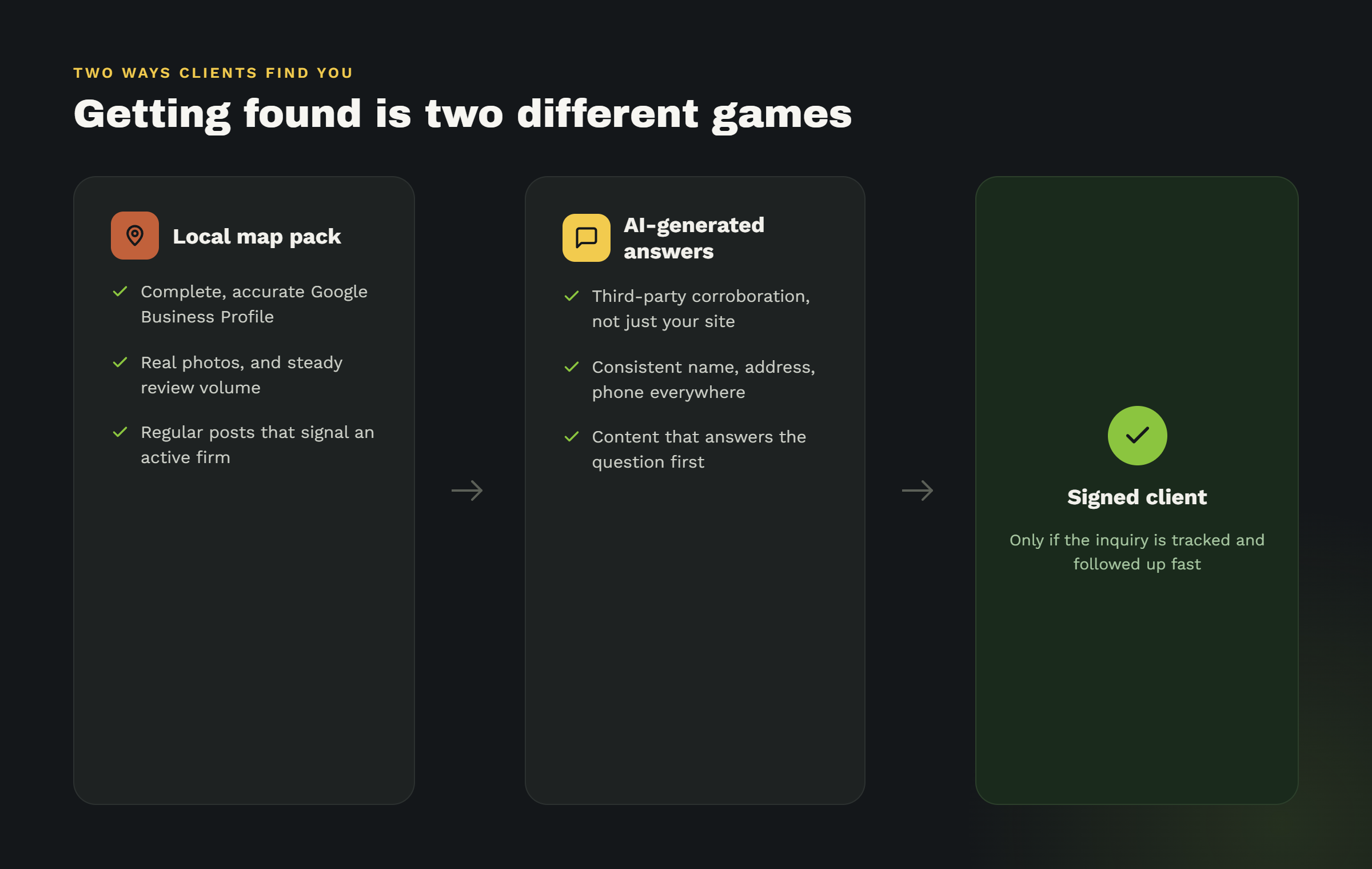
The map pack still runs on the basics
Say someone searches locally. The three listings under the map at the top of Google — the “local pack” — are often the only results they scroll past before picking up the phone. Getting into that pack, and staying there, comes down to a handful of things. They’re unglamorous. They’re also easy to get wrong.
Start with your Google Business Profile. It needs to actually be complete: firm name, address, phone number, website, every practice area you handle, hours that are actually correct. Sounds obvious. But half-filled profiles are more common than you’d think, and Google notices the gaps. Photos matter more than most firms assume, too. Real pictures of your office and your attorneys build more trust, and more engagement with the listing, than another stock photo of a gavel. Write your profile description for a person searching in your city, not for a keyword algorithm — Google can tell the difference, and so can prospective clients.
Then there’s activity. Firms that post updates — a case result, a note on a law change that affects their practice area — read to Google as active and current. Firms that set up a profile once in 2019 and never touch it again don’t. Reviews still carry real weight, too: not just your star rating, but how many you have and whether they look genuine over time. If review generation isn’t part of your intake process yet, fix that before anything else on this list.
AI answers are a different game, and most firms aren’t playing it yet
Here’s the newer part, and it’s where a lot of firms are invisible without realizing it. Someone asks an AI system a legal question — “what should I do after a car accident,” say, or “how does child custody work in my state.” The answer that comes back often doesn’t cite a law firm’s own website at all. It cites something about the firm, from somewhere else.
That’s the catch. AI engines tend to trust third-party corroboration over what a firm says about itself. A mention in a legal directory carries weight. So does a bar association listing, local press coverage, or a case that got written up somewhere independent. Each one counts for more, in an AI system’s eyes, than a page on your own site making the same claim. Your website still matters. It’s just one signal among several now, not the whole picture.
Beyond that, these systems look for a few specific things. Keep your business information consistent across every platform you’re listed on — the same name, address, and phone number everywhere. Inconsistency quietly undermines how confidently a system can identify you as a real, distinct entity. Have a credentialed attorney actually write your content, rather than handing it to a generic marketing template. And open each page with the answer instead of burying it three paragraphs down after a firm history — an AI system pulling together an answer favors whichever page hands it one cleanly.
None of this is exotic. It’s closer to good legal content practice than a technical overhaul. Most firms just haven’t gotten there yet.
Visibility that doesn’t convert is just visibility
Showing up is the first problem. The second is what happens in the ten minutes after someone finds you — and this is where firms lose people they’d already won. A prospective client who searched, found your firm, and called or filled out a form is, at that moment, comparing you to whoever else they also found. Slow response times lose that comparison quietly, and often invisibly: the person just calls the next name down the list, and you never hear about it.
We wrote recently about why referrals alone aren’t a strategy you can actually manage or measure. The same logic applies here. If you can’t see which searches, which listings, or which AI mentions actually turned into a signed client, you’re guessing at where to spend more time. Start simple: ask new clients how they found you, and actually log the answer. That alone turns local visibility from a nice-to-have into a channel you can improve on purpose.
Getting found is table stakes now, in two different systems that both reward slightly different things. Turning that visibility into signed clients is the part most firms haven’t built yet. If you want a second set of eyes on where your firm currently stands in either — the map pack or the AI answers — book a discovery call and we’ll walk through it with you.
Or email us at [email protected]



Leave A Comment